Harmonic Series With Wind Instruments
How resonating air columns in wind instruments produce the harmonic series, and why the clarinet is different.
Wind instruments work by vibrating air inside of a tube. A tube that is open on both sides will only resonate at certain frequencies. These frequencies are referred to as the harmonic series.
The lowest note of the harmonic series is often called the fundamental. On brass instruments this is also referred to as the pedal tone. How easily a player can produce it in tune depends largely on the bore profile — the shape of the tube's interior taper. A predominantly conical bore, like that of a flugelhorn, supports the fundamental well and makes the pedal tone relatively easy to produce in tune. A predominantly cylindrical bore, like that of a trumpet, favors the upper harmonics instead, making extremely high notes more accessible while making the pedal tone harder to produce cleanly. This is why a flugelhorn sits at one end of that spectrum and a trumpet at the other.
The harmonic series is a linear series. All of the frequencies in the harmonic series are multiples of the fundamental frequency. If the fundamental frequency is 100 Hz, the series would proceed as follows: 100, 200, 300, 400, 500, 600, 700, 800, ...
A frequency that is twice as much as another will sound exactly an octave higher. Because of this, the second note in the harmonic series will be an octave higher than the first. The third note will sound a perfect fifth higher than the second note, and the fourth note will sound a perfect fourth higher than the third note and an octave higher than the second note.
If the fundamental frequency of a tube is the C below the bass clef (C2), we can expect the harmonic series of that tube to look something like this:
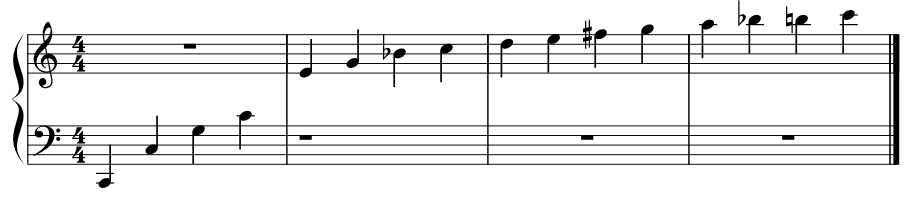
The low C would be the lowest possible note it could play, and there would be no theoretical limit to how high it could play. Many of the notes above would not be very in tune — the 7th note would be the first to be very out of tune. How far each harmonic deviates from equal temperament is covered in Harmonic Series Deviation from Equal Temperament.
Bugle calls only use notes in the harmonic series because they are the only notes that a brass instrument can play when you do not have the ability to change its length.
The bore, the vibrator, as well as the vibrating medium will affect the timbre of the perceived sound. Contrary to the intuition of most, the composition of the tube will NOT affect the timbre of the sound as long as it is airtight. This is because the medium inside the tube is vibrating to make the sound — the actual tube is not vibrating to make a sound. To illustrate what the opposite would sound like, imagine drawing a violin bow across the bell of a trumpet. Rather than producing anything resembling a musical pitch, the metal would vibrate at its own resonant frequencies — completely unrelated to the harmonic series of the air column — producing a harsh, clanging sound with no musical relationship to the instrument's intended pitches.
The clarinet family is a notable exception. The clarinet has a cylindrical bore and a reed that acts as a closed end. Together these produce a tube that supports only odd harmonics, causing the instrument to overblow at a twelfth — an octave and a fifth — rather than an octave. The saxophone also uses a reed, but its conical bore compensates for the closed end and recovers a full harmonic series, which is why it overblows at the octave despite the mechanical similarity to the clarinet. How bore profile and tube termination interact across wind instruments is covered in detail in Bore Profile and Tube Termination in Wind Instruments.